Tax Planning for Small Business Owners Choosing how your business is taxed
How your business is taxed decides how much self-employment tax you pay, how you pay yourself, and which other moves are open to you.
The four ways a business can be taxed
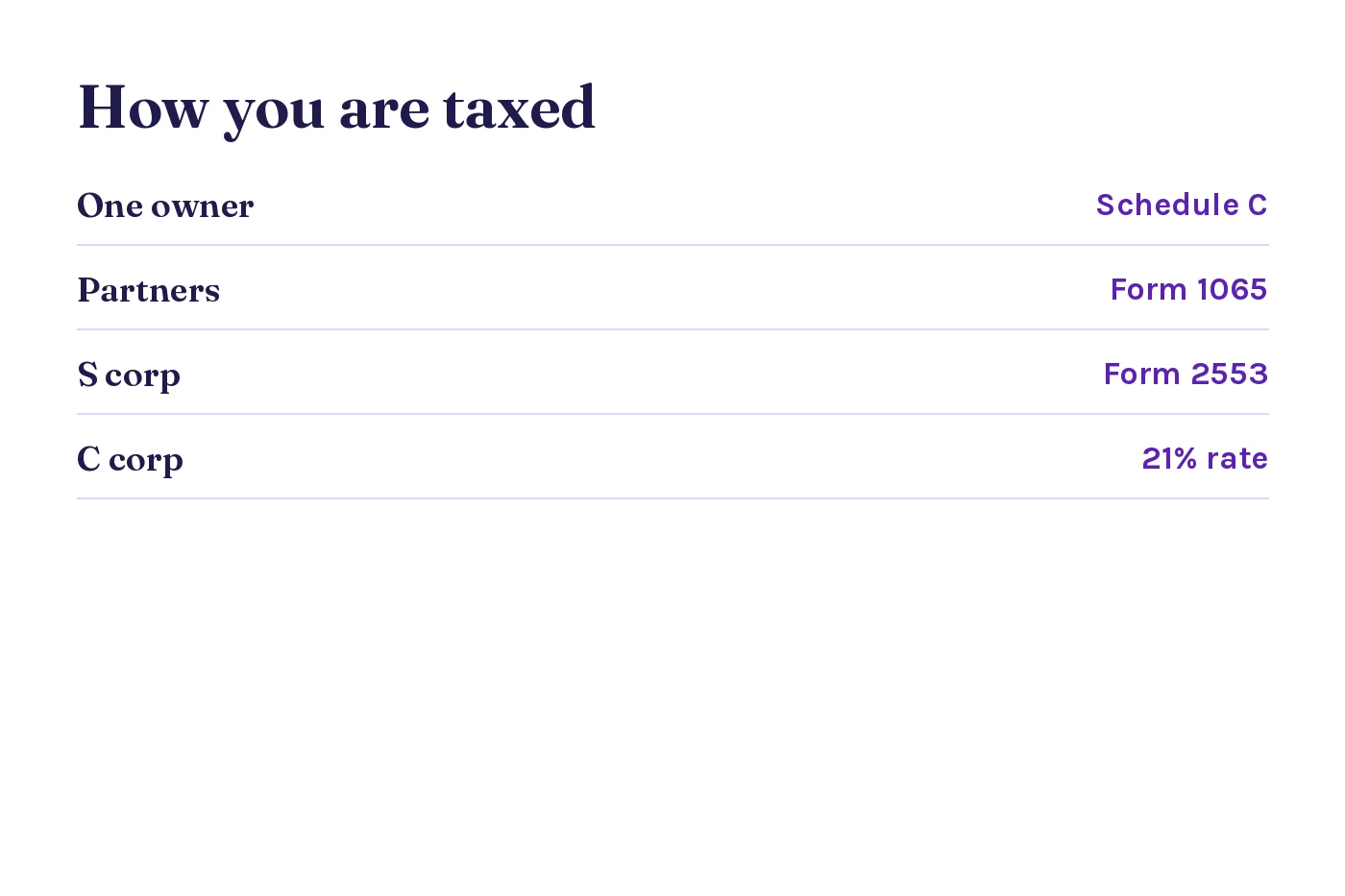
Sole proprietor. One owner, with or without an LLC. Profit goes on Schedule C with your personal return. All of it pays income tax, and almost all of it pays self-employment tax of 15.3 percent, which is Social Security and Medicare for the self-employed.
Partnership. An LLC with two or more owners is taxed this way unless it elects otherwise. The business files Form 1065, and each owner gets a K-1 with a share of the profit. For active owners, that share usually pays self-employment tax too.
S corporation. A corporation or an LLC that files Form 2553. Owners who work in the business are paid a salary through payroll, and Social Security and Medicare tax apply to the salary. Profit above the salary passes through to the owners' returns without those two taxes. The business files Form 1120-S.
C corporation. The company pays its own federal income tax at a flat 21 percent. Profit you take out as dividends is taxed again on your return. This setup usually fits a business that plans to keep its profit in the company to grow, or that's raising money from investors.
When an S corp election fits
The election pays off when your profit is steady and well above a fair salary for the work you do. The savings come from the profit above the salary. The costs come from running payroll, filing a separate business return, and sometimes state fees. A smaller QBI deduction can also give back part of the savings, because the salary doesn't count toward it.
Take a made-up consultant with $130,000 of profit. Filing as a sole proprietor, about $18,370 of it goes to self-employment tax. After an S corp election and a $65,000 salary, Social Security and Medicare on the wage are $9,945, about $8,425 less each year before the added costs. On the call, we run both versions with your real numbers so you can see what's left after the costs. Our page on a worked tax planning example carries this owner through the whole year.
How to make the election, and the deadline
File Form 2553 with the IRS. Every shareholder signs a consent. File it any time in the year before the election should start, or within the first 2 months and 15 days of that year. For a calendar-year company, that means by March 15 for the election to count for that year.
If your company is an LLC, filing Form 2553 on time handles both steps at once, and the IRS doesn't need a separate Form 8832 from you. The IRS writes back with an acceptance letter. Keep it with your company records, because a lender or a buyer may ask for it later.
If you missed the deadline
The IRS offers relief for a late election when there's reasonable cause and the company acted as an S corp would. Under Revenue Procedure 2013-30, the late Form 2553 has to be filed within 3 years and 75 days of the date the election was meant to start, with a statement explaining the reasonable cause. If the company doesn't qualify for that relief, it can ask the IRS for a private letter ruling, which carries a user fee.
If you're not sure whether an election was ever filed, last year's business return is the first clue. A Form 1120-S means the company was filed as an S corp. Our page on your S corp election letter explains how to find the acceptance and what it means for this year's plan.
Changing later
You can revoke an S corp election if the business changes, for example if it starts keeping most of its profit to grow. Once revoked, the company generally has to wait five years before electing again, so it's worth planning the change rather than making it in a rush. We look at where the business is headed before recommending either direction.
Questions about entity choice
Do I need an LLC to elect S corp status? You need a corporation or an LLC. A sole proprietor without either would form one first.
Will an S corp lower my income tax? Mostly it lowers Social Security and Medicare tax. Income tax can move a little either way, mainly through the QBI deduction and the deductible half of payroll tax. We figure both on the call.
Want to know which setup fits your business?
Tell us how the business is set up today and roughly what it made last year.
You will be talking to the Steven Palmieri practice.