Tax Planning for Small Business Owners A tax planning example for a small business owner
One made-up owner, one year, and every planning move worked out with the numbers shown. Your numbers will be different.
The assumptions
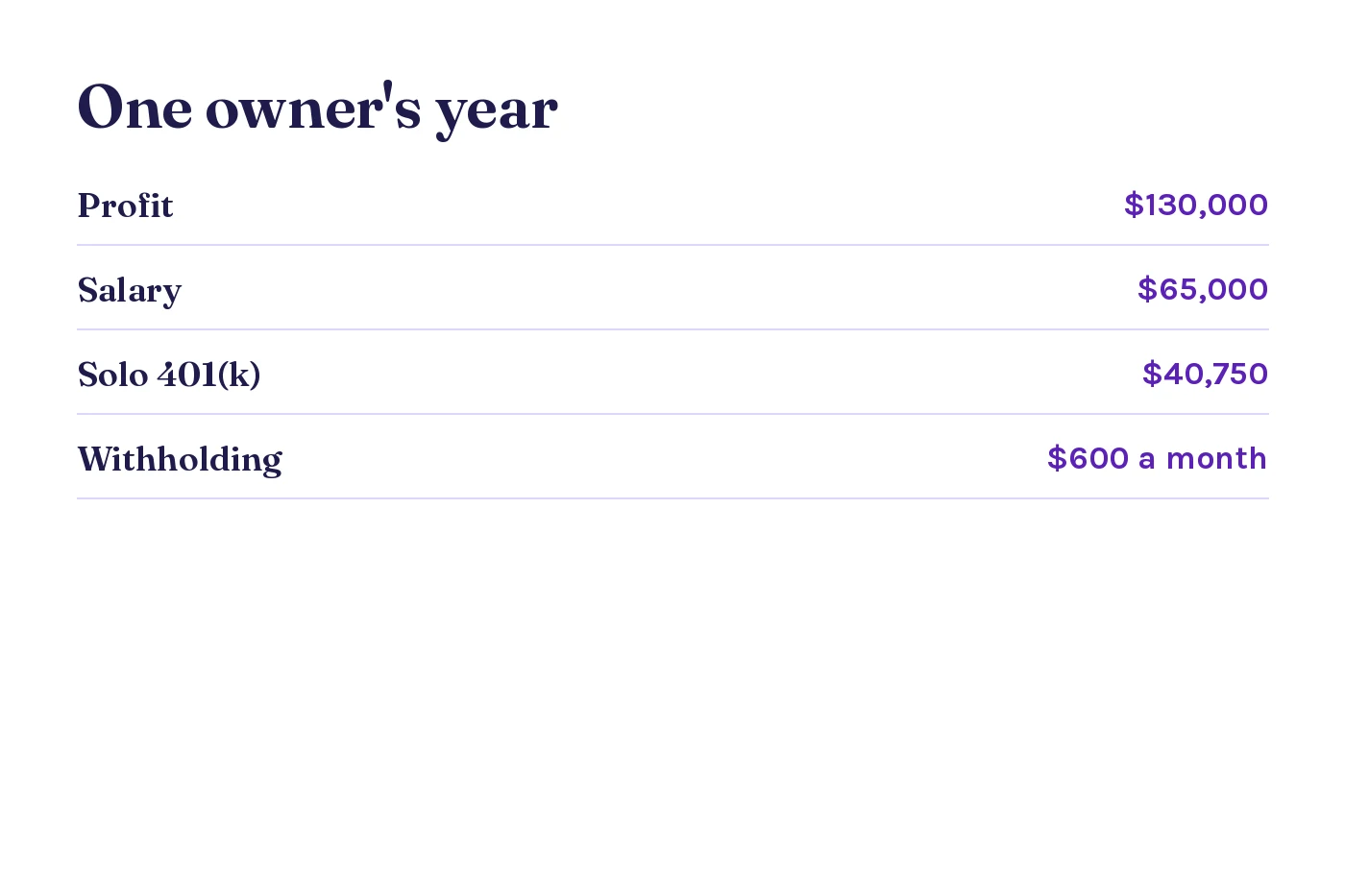
This owner is made up. She's a consultant with a one-owner LLC, files single, has no other income and no employees, and expects $130,000 of profit in 2026 before paying herself. Last year she was taxed as a sole proprietor, and her total federal tax was $30,000, most of it self-employment tax. The figures below are federal only. State tax, and the cost of each move, are figured on the call.
January: choose how the business is taxed
Left on Schedule C, her self-employment tax is 15.3 percent of 92.35 percent of profit, about $18,370.
As an S corp, she pays herself a salary through payroll. Consultants doing her kind of work earn about $65,000, so that's her wage. Social Security and Medicare on $65,000 come to $9,945, split between the company and her paychecks, roughly $8,425 below the Schedule C figure. Payroll and a separate S corp return add cost, and the QBI deduction gets smaller, so part of that comes back. In this example the savings are larger than those costs. At a lower profit they may not be, and that's the first thing we check on the call.
To count for 2026, Form 2553 was due in mid-March 2026. If you're reading this late in the year, the same plan can start next January, with the form due by March 15.
Also in January: open a Solo 401(k)
On a $65,000 wage, she can defer up to $24,500 of her own pay in 2026, and the company can add 25 percent of the wage, $16,250. Together that's $40,750, comfortably inside the $72,000 cap.
Her deferrals come out of each paycheck, about $2,042 a month. The company's $16,250 can be deposited as late as the business return's filing date.
What the salary and the 401(k) do to her income tax
The company deducts her wage, its half of payroll tax ($4,972.50) and its $16,250 retirement deposit, which leaves about $43,778 of S corp profit on her return. Her QBI deduction is 20 percent of that, about $8,756. After the 2026 standard deduction of $16,100, her taxable income lands near $59,400.
Skip the Solo 401(k), and taxable income would be about $96,900. The plan cuts it by about $37,500, all inside the 22 percent bracket, for roughly $8,250 less federal income tax in 2026. She pays income tax on the 401(k) money when she takes it out in retirement. The accountable plan and the December purchase below lower her profit a little more, and this section shows the salary and the 401(k) alone.
Every month: an accountable plan
She works from a home office and uses her own phone and car for the business. Under an accountable plan, she sends the company a short report each month with records, and the company pays her back $300 a month, or $3,600 a year. Those payments aren't wages, so they carry no payroll tax, and the company deducts them.
The four estimate dates: covered by withholding
Her safe harbor is the smaller of 90 percent of this year's tax and 100 percent of last year's $30,000. With Social Security and Medicare now paid through payroll, the tax left on her personal return is mostly income tax, about $7,800, so 90 percent of it, about $7,000, is the smaller target.
She has payroll withhold $600 of federal income tax a month, $7,200 for the year. The IRS treats withholding as paid evenly through the year, so that covers all four dates, April 15, June 15, September 15 and January 15, with no separate estimates. If her profit runs ahead of plan, the October review raises the withholding on her last paychecks.
December: one purchase the business needed
In October her forecast shows profit right on plan. She had planned to replace a $12,000 piece of equipment in January. Buying it and putting it in use by December 31 moves the $12,000 deduction into 2026. It also lowers her S corp profit and her QBI deduction a little, which we count in the October review. She buys it only because the business needed it.
Hiring family: not in this example
She has no children working in the business. If she did, her S corp would pay Social Security and Medicare tax on their wages like anyone else's, because the payroll-tax break for a parent's business applies only to sole proprietorships and partnerships owned by the parents. Fair pay for real work would still be a business deduction. Our page on hiring your kids or spouse covers the rules.
Her plan on one page
Salary of $65,000 through payroll. 401(k) deferral of about $2,042 a month, plus $16,250 from the company. Accountable plan payments of $300 a month. Federal income tax withholding of $600 a month, which covers the four estimate dates. A mid-year check in June and a year-end review in October, with the equipment purchase in December. That's the kind of plan we write with you, using your own numbers, after the free 30-minute call.
Want us to run this with your numbers?
Tell us how the business is set up and roughly what it made last year.
You will be talking to the Steven Palmieri practice.