Tax Planning for Small Business Owners Tax planning for Texas small business owners
Steven Palmieri works from the practice in Dallas. Owners anywhere in Texas can meet by video, and the same practice keeps the books, the plan and the returns.
No state income tax, so the federal plan is most of the plan
Texas has no personal income tax. Your S corp salary, your distributions and your sole proprietor profit don't add a state income tax bill, the way they would in many states. So for a Texas owner, the eight federal moves on this site are nearly the whole plan: how the business is taxed, the owner salary, a retirement plan, the QBI deduction, estimates, an accountable plan, family payroll and year-end timing.
Two Texas filings sit beside that plan: the franchise tax report each May, and sales tax if the company sells taxable goods or services. We plan the federal moves first, then put the Texas dates on the same calendar.
The May 15 franchise report
Every Texas LLC and corporation files a franchise report by May 15, S corp or not. On the 2026 and 2027 reports, a company with revenue of $2,650,000 or less owes nothing and skips the tax report. What it still files is Form 05-102, the Public Information Report, and that filing is what keeps the company in good standing.
Bigger companies pay 0.75 percent of their margin, and retailers and wholesalers pay half that rate. Under $20 million of revenue there's also a flat option, the EZ computation, which charges 0.331 percent of revenue and skips the margin deductions. Most companies can push the filing date to November 15 with an extension. Filing late draws a $50 penalty, and unpaid tax picks up 5 percent in the first month and 10 percent after that.
How the owner salary changes the Texas margin
Texas lets a company figure its margin several ways, and one of them is revenue minus compensation. What counts is pay that went through payroll and landed on a W-2, with a cap of $480,000 per person for the 2026 and 2027 reports. Draws an owner took outside payroll don't count, and neither do payments to contractors on a 1099. So the owner salary you set in January for federal reasons can also lower the Texas margin in May. We run the margin methods with your real payroll and pick the one that costs least.
Retirement contributions and health coverage the company pays can count as compensation too. That's one more reason to set the salary, the retirement deposit and the Texas report from the same closed books.
Sales tax, if you collect it
The state rate is 6.25 percent, and local rates can add up to 2 percent more, for a top combined rate of 8.25 percent. Returns are due on the 20th: monthly, quarterly or yearly, on the schedule the Comptroller assigned when your permit was approved. Filing on time earns a small discount. Sales tax you collect belongs to the state, so it's never income and never a deduction.
An example, not a client
Picture a bakery in the Hill Country with $900,000 of sales. The owner keeps the books current through September. We plan the federal moves first: her salary, her retirement plan and her estimates. In May, her revenue is under the no-tax line, so she files only the Public Information Report. Her sales tax return is due on the 20th of each month, and her payroll register feeds both her federal return and, in a bigger year, the compensation figure on the franchise report.
Your numbers will differ. Bring last year's return, this year's profit so far, and last year's franchise report if one was filed, and we'll plan the Texas year with you on a free 30-minute call.
Where the Texas figures come from
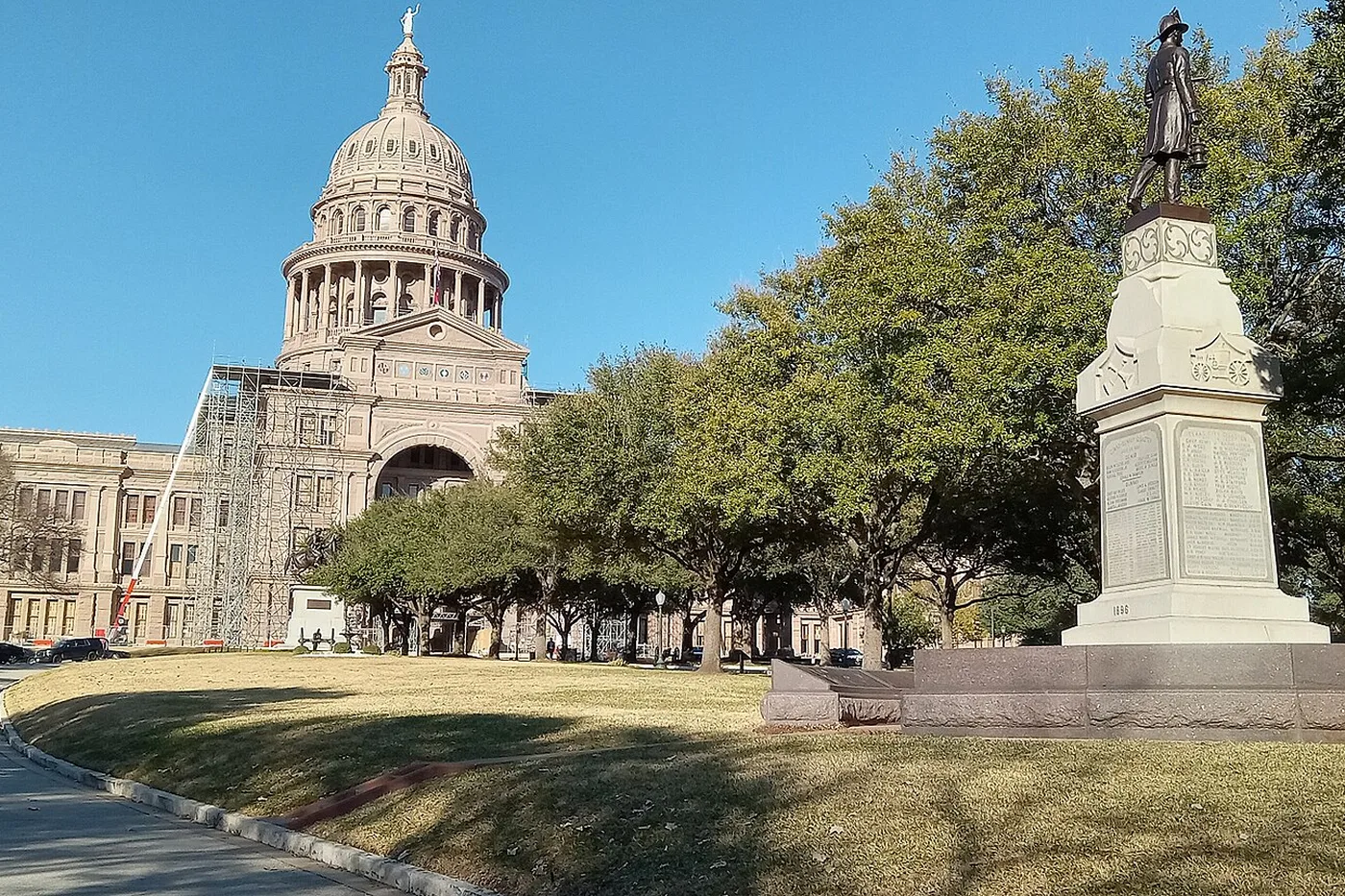
The franchise thresholds, rates and dates are on the Comptroller's franchise tax pages, and the sales tax rates and due dates are on its sales tax pages. We check them each year before a report goes in. The photograph at the top is the Texas State Capitol with the Volunteer Firemen Monument, by CupWithSoda19, shared under CC BY-SA 4.0 on Wikimedia Commons.
Tell us about your Texas business.
Tell us what the business does and whether a franchise tax report is already on your list.
You will be talking to the Steven Palmieri practice.