Tax Planning for Small Business Owners Your October tax planning checklist
October is the best month to check the year. You know most of your profit, and there's still time to act before December 31.
Why October works so well
By October you have nine months of real numbers, so a forecast to December 31 is close to what will happen. You also have three months left, which is enough time to change payroll, buy equipment you need, or put more into a retirement plan. In December some of those moves get rushed, and a few can't be made at all.
Go through the checklist below with your books up to date through September. If you'd rather go through it with us, book the free 30-minute call and bring your numbers.
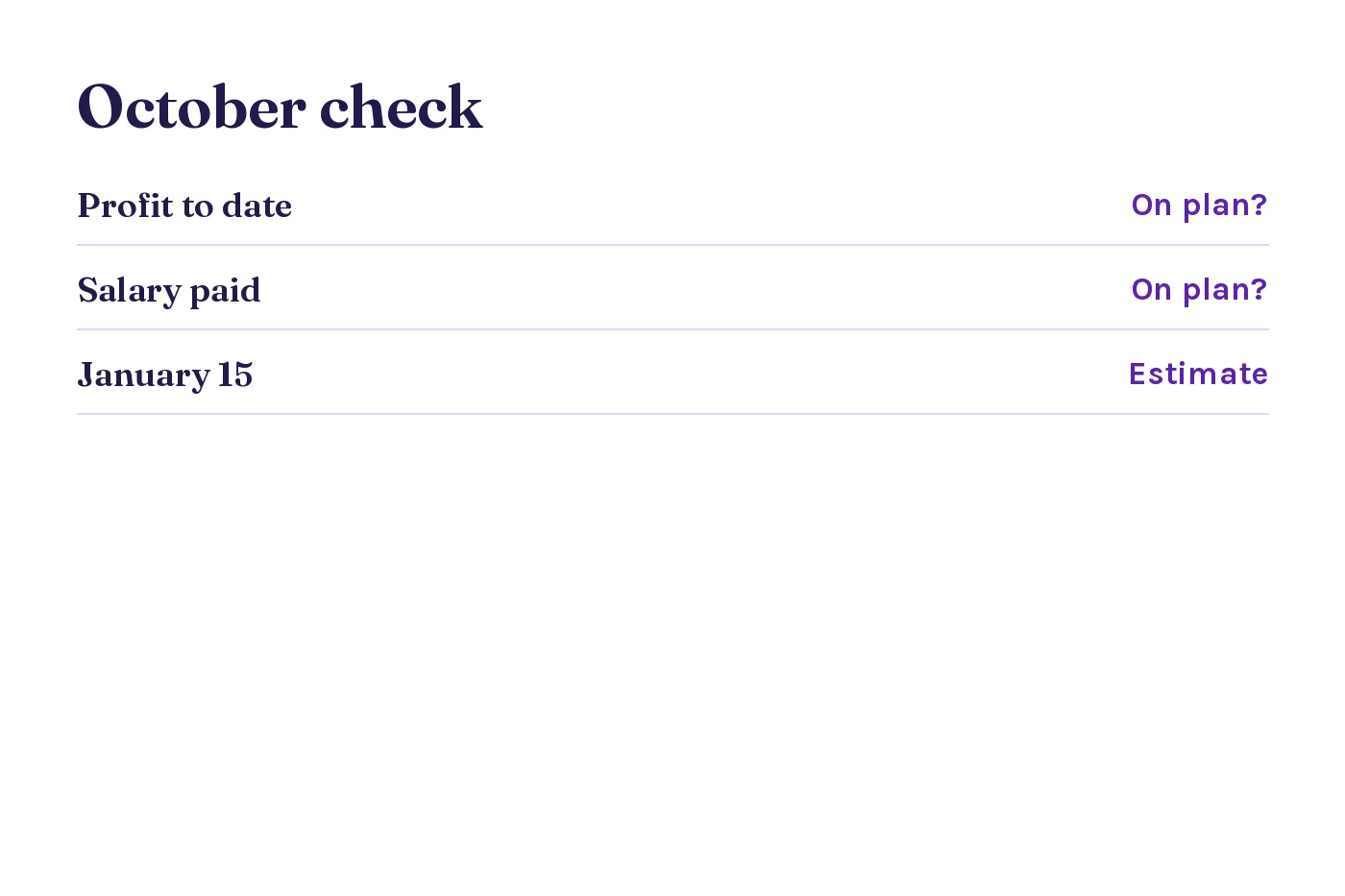
1. Forecast your profit to December 31
Start with profit through September, then add what you expect for October, November and December. Use last year's fourth quarter as a guide if your business is seasonal. This forecast drives every other item on the list, so it's worth half an hour.
2. Check your owner salary
If you're an S corp, compare what payroll has paid you so far with the salary in your plan. If the year turned out bigger or smaller than expected, you can raise or lower the remaining paychecks so the full-year salary still fits your work. Make the change before the last payrolls of the year run. Our page on setting your owner salary explains how to pick the number.
3. Check what's left for retirement
Money you defer into a 401(k) from your own pay has to come out of paychecks by December 31. If you want to reach the $24,500 limit for 2026, divide what's left by the number of paydays remaining. The company's share and a SEP IRA deposit can wait until the business return is filed, so they can be sized once the year is closed.
4. Size the January 15 estimate
Add up the estimates you've paid and the federal tax withheld from your paychecks. Compare that with the safe-harbor amount: 100 percent of last year's tax, or 110 percent if last year's adjusted gross income was over $150,000. The January 15 payment covers what's left. Our page on quarterly estimated taxes has the full rule.
5. List the purchases the business needs
If you already plan to buy a vehicle, equipment or software early next year, buying it and putting it in use by December 31 can move the deduction into this year. Write down what you need, what it costs and when you could buy it. Then decide with the forecast in front of you, because a purchase only makes sense if the business needs it. Ask the seller when the item can be delivered and set up, because the deduction depends on the item being in use by December 31.
6. Catch up the accountable plan and family payroll
If your company pays you back for a home office, a phone or mileage, submit the reports for the year so far and get reimbursed before year end. If your kids work in the business, check that their hours are recorded and their pay went through payroll.
7. Decide on next year's setup
If the year showed that an S corp election would help, now is the time to plan it, so payroll can start in January. For a calendar-year company, Form 2553 for next year is due by March 15. The full checklist for the months ahead is on the October tax planning agenda.
What if your books aren't current?
Then the first step is catching up through September, because every item above needs real numbers. Catching up a few months usually takes days, and it often turns up deductions that were missing from the bank feed. We can do that catch-up with you and then go through the checklist. Tell us how far behind the books are in the form below.
Want us to go through the checklist with you?
Tell us what the business does and roughly what it has made so far this year.
You will be talking to the Steven Palmieri practice.