Tax Planning for Small Business Owners Retirement plans that lower your tax
A retirement plan is one of the few moves that lowers this year's income tax and builds your savings at the same time.
How a retirement plan lowers your tax
Money you put into a traditional retirement plan comes off this year's taxable income. You pay income tax on it later, when you take it out in retirement. For an owner in the 22 percent bracket, every $1,000 put in lowers this year's federal income tax by about $220.
The right plan depends on whether you have employees, how much you want to put in, and how late in the year you decide. Here are the three plans most small businesses use.
Solo 401(k): for an owner with no employees
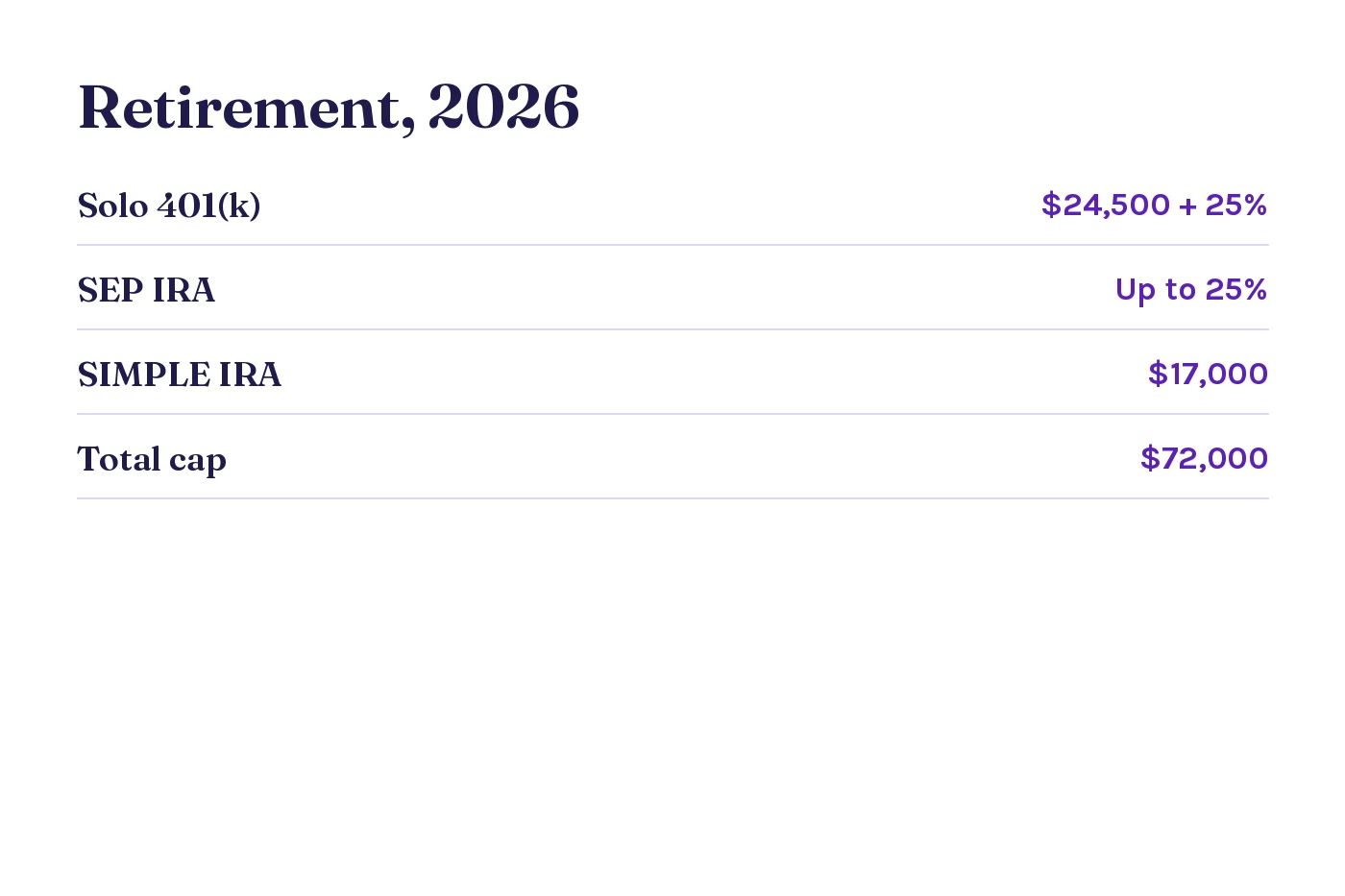
A Solo 401(k), also called a one-participant 401(k), covers a business owner with no employees, or the owner and a spouse. It has two parts. As the employee, you can defer up to $24,500 of your pay in 2026, plus $8,000 more if you're 50 or older, or $11,250 more if you're 60 to 63. As the employer, the business can add up to 25 percent of your compensation. The total for 2026 can't go over $72,000, not counting catch-up amounts.
For a sole proprietor, the employer share is figured from net earnings from self-employment with a separate calculation, which comes out lower than 25 percent of profit. For an S corp owner, it's 25 percent of the W-2 salary. Your own deferrals have to come out of paychecks during the year, so set them up early.
SEP IRA: simple, and you can decide late
A SEP IRA takes only employer contributions, up to 25 percent of each employee's pay, with a $72,000 cap for 2026. You can set one up and fund it as late as the due date of your business tax return, extensions included. That makes it the plan to use when you want to wait until the year is closed to decide how much to put in.
The catch is employees. If you have eligible employees, the business has to contribute the same percentage of pay for each of them. That's why a SEP fits best when it's just you, or you and a very small team.
SIMPLE IRA: for a small team
A SIMPLE IRA lets employees, including you, defer up to $17,000 of pay in 2026, plus $4,000 more at age 50 or older. The business either matches deferrals up to 3 percent of pay or puts in 2 percent of pay for every eligible employee. A new SIMPLE IRA generally has to be set up by October 1 to count for that year.
A worked example
Here's an example with made-up numbers. An S corp owner pays herself an $80,000 salary. With a SEP IRA, the company can put in 25 percent of the salary, which is $20,000. With a Solo 401(k), she can defer $24,500 of her own pay and the company can add the same $20,000, for $44,500 in total.
So at this salary, the Solo 401(k) allows more than twice as much. The SEP is easier to run and can be opened later. On the call we compare both at your salary and pick an amount your cash can carry, because money in the plan is money the business no longer has to spend.
Deadlines that matter
Your own 401(k) deferrals come out of paychecks by December 31. The employer share of a 401(k) and a SEP contribution can be made up to the business return's due date, including extensions. An IRA deposit for the year can be made until the April filing deadline. A plan you open early in the year gives you the most choices.
Questions about retirement plans
Can I have a Solo 401(k) if my spouse works in the business? Yes. A spouse is the one employee a Solo 401(k) allows, and the spouse can make deferrals too.
What if I already have a plan and haven't funded it? Bring the plan's name and what you've put in so far to the call. We figure what's left this year and when each part is due.
Want help picking a retirement plan?
Tell us how the business is set up, whether you have employees, and any plan you already have.
You will be talking to the Steven Palmieri practice.