Tax Planning for Small Business Owners Planning for the QBI deduction
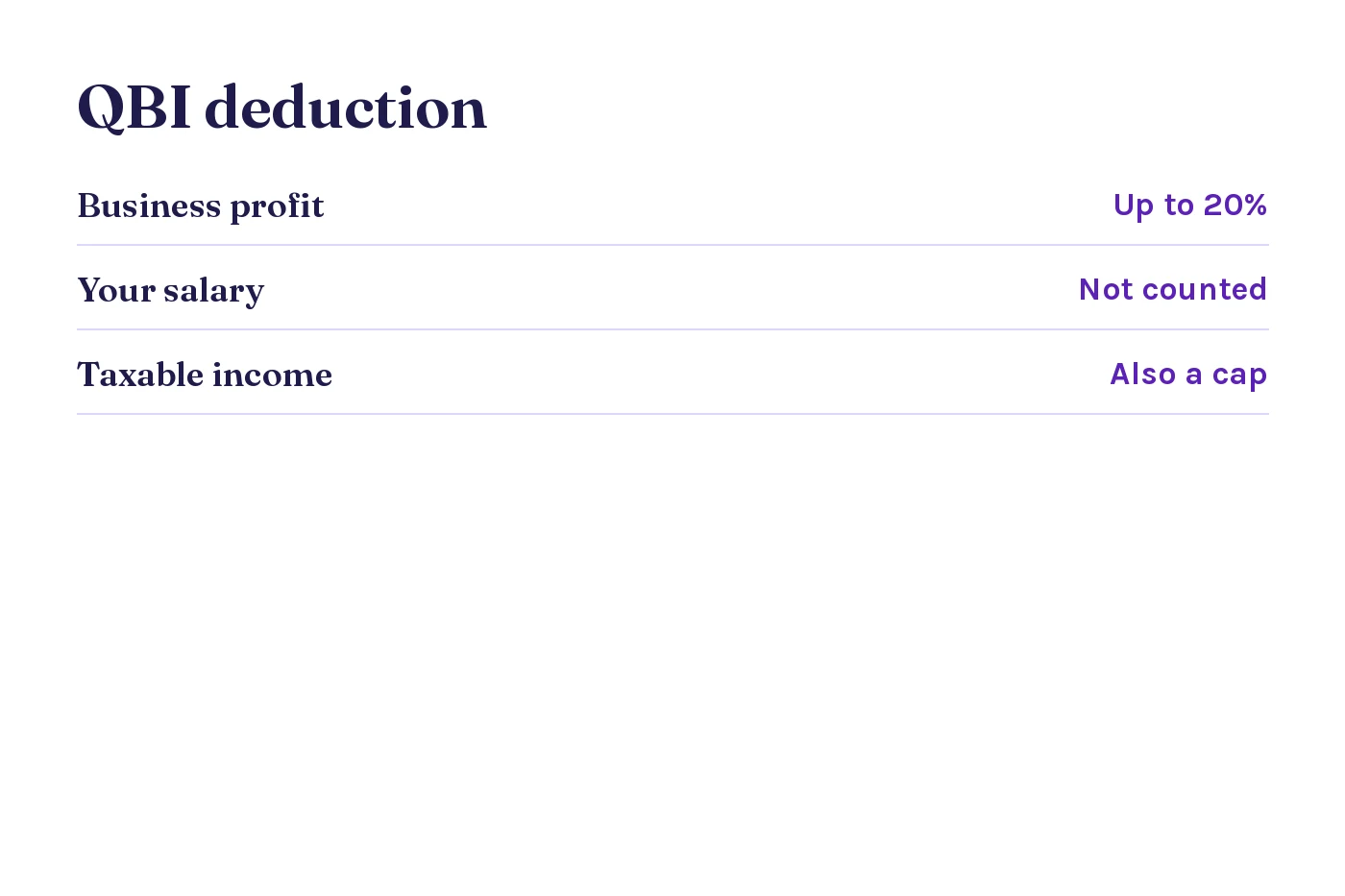
Many owners can deduct up to 20 percent of their qualified business income. Your salary, your retirement deposits and your income all change how much you get.
What the QBI deduction is
The qualified business income deduction lets many owners of sole proprietorships, partnerships and S corporations deduct up to 20 percent of their qualified business income. You take it on your personal return whether or not you itemize.
Qualified business income is the profit from your business, less a few related deductions such as the deductible half of self-employment tax, self-employed health insurance and retirement contributions. It doesn't include wages you earn as an employee, your S corp salary, guaranteed payments from a partnership, or income earned through a C corporation.
The two numbers that set the deduction
The deduction is generally the smaller of two amounts: 20 percent of your qualified business income, or 20 percent of your taxable income before the deduction, not counting net capital gains. For many owners with a spouse's wages or other income, the first number decides. For an owner whose business is most of their income, the second number often does.
A worked example
Here's an example with made-up numbers. A sole proprietor, filing single with no other income, has $80,000 of profit in 2026. Self-employment tax is about $11,304, and half of it, $5,652, is deductible. That makes qualified business income about $74,348, and 20 percent of it is $14,870.
Her taxable income before the deduction is $80,000 minus $5,652 minus the $16,100 standard deduction, or $58,248. Twenty percent of that is $11,650. The smaller number wins, so her deduction is $11,650. It comes off the top of her income, where $7,848 of it falls in the 22 percent bracket and the rest in the 12 percent bracket. That's about $2,180 less federal income tax.
How salary and retirement deposits change it
If you're an S corp owner, your salary isn't qualified business income, so each dollar of salary lowers the deduction by up to 20 cents. That's one reason the salary should fit your work and not run higher than it needs to.
Retirement deposits work the same way. The company's deposit for you lowers business profit, so it lowers the deduction a little. The deposit still saves more than it costs, but the plan should count both. We set the salary, the retirement deposit and the QBI deduction together for this reason.
Limits at higher incomes
Above a taxable-income threshold the IRS sets each year, more rules apply. The deduction can be limited by the wages the business pays and the property it owns. For a specified service business, such as health, law, accounting, consulting, financial services, athletics or the performing arts, the deduction phases out above the threshold. The IRS also describes changes for tax years after 2025, including a minimum deduction for owners with active business income.
If your income is near the threshold, timing moves like a retirement deposit or a year-end purchase can keep more of the deduction. That's a good reason to look at the forecast in October.
Questions about the QBI deduction
Does a rental property count? Sometimes. A rental that rises to the level of a business can qualify. We look at how you run it.
Is the QBI deduction automatic? It's figured on your return, but the amount depends on choices made during the year. Planning is how you keep it.
Want us to check your QBI deduction?
Tell us how the business is set up and roughly what your income was last year.
You will be talking to the Steven Palmieri practice.