Tax Planning for Small Business Owners Setting your owner salary in an S corp
Your S corp salary has to fit the work you do. We help you set a number you can defend, and set up payroll with the provider you pick.
How owner pay works in an S corp
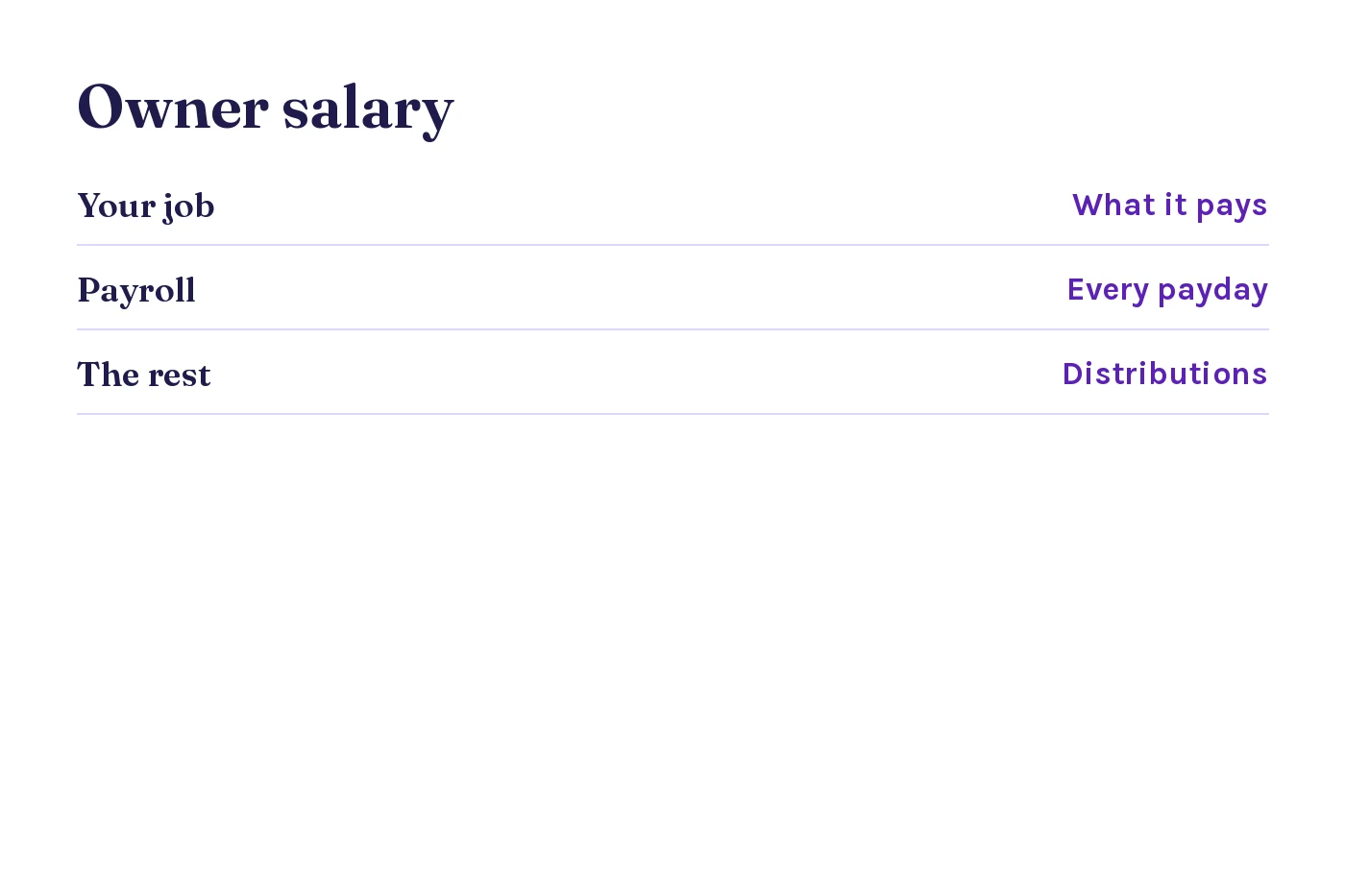
In an S corp, an owner who works in the business is an employee. Pay for your work goes through payroll as a wage, with Social Security, Medicare and income tax withheld. What's left of the profit can come out as distributions, and distributions don't carry Social Security or Medicare tax.
That split is where the savings come from, so the IRS expects the salary to be reasonable for the work. If it's too low, the IRS can treat distributions as wages and add the payroll taxes, plus penalties and interest.
What reasonable means
Think of reasonable pay as the wage you'd have to offer an outside hire to take over your role. The IRS looks at your training and experience, your duties and responsibilities, the time you spend on the business, what similar businesses pay for similar work, and what the business can afford. An owner who runs a busy shop full time needs a higher salary than one who works ten hours a week.
We look at what your role pays in your field and your area, then write down how we got the number. That record is what you'd show if the IRS asked.
What each $10,000 of salary costs
Social Security and Medicare tax together are 15.3 percent of salary, half paid by the company and half withheld from your check. So each $10,000 of salary carries about $1,530 of those taxes, until your wages reach the Social Security wage base. The salary also lowers the QBI deduction, because salary doesn't count as qualified business income. A higher salary does raise how much you can put in a 401(k).
A worked example
Here's an example with made-up numbers. An S corp owner runs a two-truck service company and works about 50 hours a week. Profit before her pay is $200,000. Managers who run similar operations in her area earn $80,000 to $95,000, so she sets her salary at $90,000.
Social Security and Medicare tax on $90,000 is $13,770. The company's half, $6,885, is a business deduction. The remaining profit, about $103,000, can come out as distributions without those two taxes. Because she's paid through payroll, she can also defer up to $24,500 into a Solo 401(k), and the company can add up to $22,500, which is 25 percent of her salary.
Setting up payroll
We set payroll up with the provider you pick, and you run each payday with that provider. We set the salary, the withholding and any 401(k) deferral, and we record each payroll in the books. Most owners run payroll monthly or twice a month. Paying the salary through the year, instead of in one lump in December, keeps the record clean and the withholding even.
If you've been taking draws
Many new S corp owners take money out as draws before payroll is set up. If that's you, tell us how much you've taken and when. We set up payroll for the rest of the year, set the salary so the full year fits your work, and record the draws correctly in the books.
Questions about owner salary
Can I change my salary during the year? Yes. If the year turns out bigger or smaller than planned, we adjust the remaining paychecks.
Does a sole proprietor need a salary? No. A sole proprietor pays self-employment tax on profit instead. The salary question starts with the S corp election.
Want help setting your salary?
Tell us what you do in the business, how many hours you work, and roughly what it makes.
You will be talking to the Steven Palmieri practice.