Tax Planning for Small Business Owners Accountable plans: how your company pays you back
If you pay business costs out of your own pocket, an accountable plan lets your company pay you back, deduct the cost, and skip payroll tax on it.
Who it's for
An accountable plan helps owners who work for their own S corp or C corp and pay some business costs personally. Common examples are the business share of a home office, a cell phone used for work, business mileage on a personal car, and supplies bought on a personal card.
A sole proprietor deducts those costs directly on Schedule C, so an accountable plan isn't needed there.
The three rules
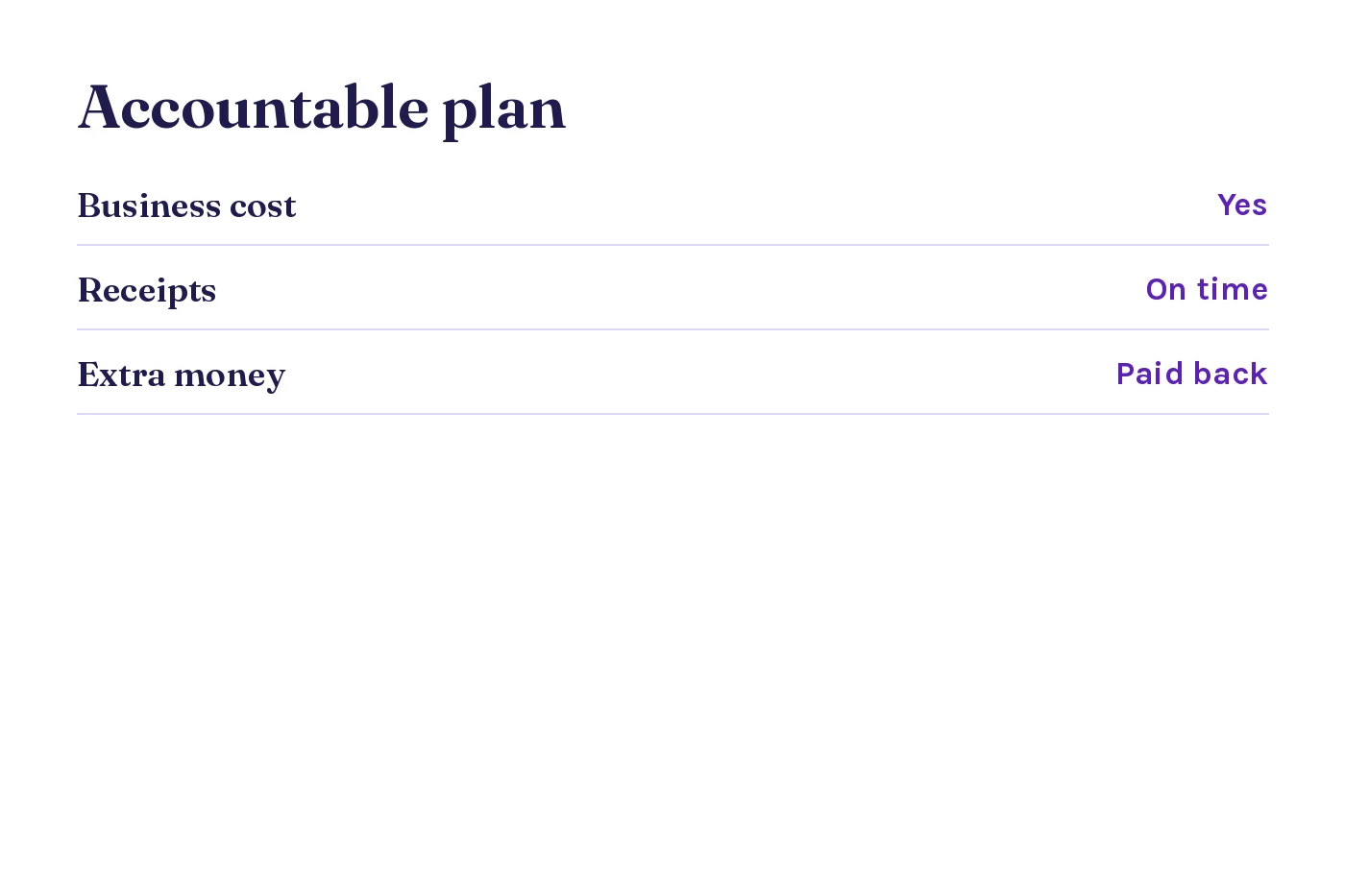
The cost has to be for the business. The plan only pays back expenses you had while working for the company.
You account for it. You report each expense to the company with records, such as receipts or a mileage log, within a reasonable time.
You return any extra. If the company paid you more than the expense, you pay back the difference within a reasonable time.
When the plan follows all three rules, the payments aren't wages. No income tax or payroll tax is withheld, they don't show on your W-2, and the company deducts them as business expenses. If the rules aren't followed, the payments are treated as taxable wages.
How to set one up
The company adopts a short written plan that states the three rules and the kinds of costs it covers. Then you follow a simple routine: once a month, you send the company a report with the costs and the records, and the company pays you back from its account. We write the plan, set up the report, and record each payment in the books.
A worked example
Here's an example with made-up numbers. An S corp owner uses 15 percent of her home as a dedicated office. Her rent and utilities come to $24,000 a year, so the office share is $3,600. She also uses her phone half for work, a $1,200 yearly bill, so $600 of it is business. Her company pays her back $4,200 for the year under its accountable plan.
The company deducts the $4,200. She pays no income tax or payroll tax on it, because it pays back costs she already had. If the company had raised her salary by $4,200 instead, she'd have paid income tax on it, and the two of them would have paid about $643 of Social Security and Medicare tax.
Keeping it clean
Keep receipts, a mileage log and a simple measurement of the office space. Submit reports on a regular schedule, monthly works well, and avoid paying flat allowances without records. Reimbursements paid in December for costs from all year are fine, as long as the reports are done.
Questions about accountable plans
Can the company pay for my car? It can pay back the business use of your car, with a mileage log. Owning a car in the company is a separate decision with its own rules.
Is it too late to start one this year? No. The company can adopt a plan now and pay back qualifying costs you report with records.
Want an accountable plan for your company?
Tell us how the company is set up and which costs you pay yourself.
You will be talking to the Steven Palmieri practice.